
Your WooCommerce SEO for stores that need speed and structure Heading
Your Why WooCommerce SEO needs a specialist Heading
Because WooCommerce sits on WordPress, the fix combines two skill sets: eCommerce SEO strategy — category targeting, product optimisation, buyer-intent content — and deep WordPress technical work, from database and hosting performance to plugin bloat and Core Web Vitals. That combination is precisely my home turf, and it is why WooCommerce stores are some of the most satisfying projects I take on: the ceiling is usually far higher than the owner realises. Heading
Your Speed is the WooCommerce battleground Heading
Your What is included in WooCommerce SEO services Heading
WooCommerce technical audit
A full crawl covering attribute and filter URLs, pagination, canonical issues and the crawl waste WooCommerce generates at scale.
Speed and Core Web Vitals work
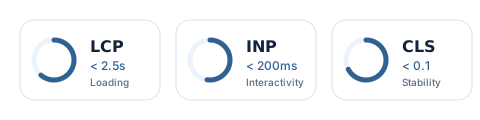
Theme, plugin, image and hosting-level optimisation targeting the metrics Google actually ranks on.
Category page optimisation
Turning product category archives into genuine ranking pages with real copy and keyword targeting.
Product page SEO
Unique descriptions, optimised titles and complete product schema for rich results.
Plugin and database cleanup
Removing redundant plugins and taming the database bloat that slows everything down.
Content strategy
Buying guides and comparisons that capture researching shoppers and feed your category pages.
Your My WooCommerce SEO process, step by step Heading
-
1
Technical and speed audit
Every crawl, structure and performance issue mapped and ranked — including the plugin-by-plugin speed cost.
-
2
Keyword to category mapping
Commercial keyword research mapped onto your category structure, restructuring where demand justifies it.
-
3
Foundation fixes
Speed, duplicates and crawl control shipped before any content — so everything after compounds.
-
4
Category and product rollout
Priority categories optimised by hand, products handled through smart templates at scale.
-
5
Revenue-tied reporting
Rankings tracked against orders per category, so budget follows what actually sells.
Your Who WooCommerce SEO is for Heading
It also fits store owners choosing between platforms. If you are weighing WooCommerce against Shopify, I will give you a straight answer for your situation rather than a sales pitch for either — I work on both, and the honest comparison depends on your catalogue, your team and your appetite for maintenance. And if your store is already healthy, the same engagement scales it: WooCommerce responds beautifully to systematic category and content work once the foundations are solid. Heading
Your Why it matters Heading
Uncapped growth
Fixing speed and structure removes the ceiling every future page inherits.
Rankings and conversions together
WooCommerce speed work pays twice — in positions and in checkout rate.
Full ownership
Unlike closed platforms, every fix on WooCommerce is yours to keep and control.
Lower ad dependence
Every category that ranks organically is acquisition cost you stop paying.
Your Why work with me on WooCommerce SEO Heading
Your Proof it works Heading
Your WooCommerce SEO FAQ Heading
Is WooCommerce or Shopify better for SEO?
Both rank well when managed. WooCommerce offers total control but demands maintenance; Shopify is simpler but constrained. The honest answer depends on your catalogue, team and budget — ask me on a call and I will give you a straight recommendation.
My WooCommerce store is very slow — can that really be fixed?
Almost always, yes. Speed problems come from a diagnosable stack of causes: theme, plugins, images, database and hosting. I fix them in order of impact, and the improvement shows in both rankings and conversion rate.
Will you break my store making changes?
No — everything meaningful is tested on staging first, and I work with your developer or hosting where needed. A live store is treated like a live store.
Which SEO plugin should I use?
Any of the major ones works fine when configured properly — the plugin is maybe five percent of WooCommerce SEO. The rankings live in speed, structure, categories and content, which no plugin does for you.
How many products can you handle?
From fifty to fifty thousand. At scale the work shifts from hand-editing to smart templates, category prioritisation and crawl control — the approach adapts, the principles do not.