
Your Turn your store into an organic sales channel Heading
Your What eCommerce SEO involves Heading
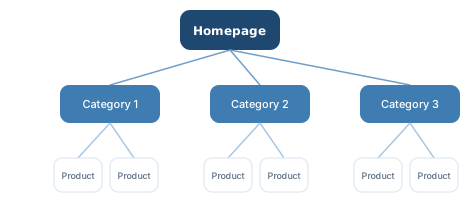
Done well, it compounds beautifully. Rank one category strongly and every product beneath it benefits from the authority flowing down. Get your architecture and internal linking right and new products start ranking faster because the foundation is already there. Most stores leave this on the table — they rely on brand searches and paid traffic while their category pages, which should be traffic magnets, sit thin and unoptimised. Heading
Your Architecture is everything in eCommerce Heading
Your What is included Heading
Category page optimisation
Turning thin category pages into genuine ranking assets with the right copy, structure and internal links.
Product page SEO
Optimised titles, descriptions and product schema so your listings win rich results and clicks.
Faceted navigation and crawl control
Taming filters and parameters that create duplicate content and waste crawl budget.
Buyer-intent content
Comparison guides and content that captures shoppers researching before they buy.
Technical and speed fixes
A fast, clean store — because on eCommerce, speed is both a ranking and a conversion factor.
Platform-specific work
Deep optimisation for Shopify, WooCommerce or Magento, working around each platform quirks.
Your Why it matters Heading
Traffic that converts
You rank for people actively searching to buy — the highest-value visitors there are.
Lower reliance on ads
Organic rankings reduce your cost per acquisition and de-risk your whole store.
It compounds
Strong categories lift every product beneath them, and new products rank faster.
Faster, better UX
Speed and structure work lifts rankings and checkout conversion together.
Your Why work with me on eCommerce SEO Heading
Your My eCommerce SEO process, step by step Heading
-
1
Store audit and keyword mapping
A technical crawl of the store plus buyer-intent keyword research, mapping every commercial keyword to the right category or product page.
-
2
Architecture and crawl control
Restructuring categories, taming faceted filters and duplicate URLs, and pointing crawl budget at the pages that sell.
-
3
Category and product optimisation
Titles, copy, internal links and product schema across your highest-potential categories first, then rolled out through templates.
-
4
Buyer-intent content
Comparison and buying-guide content that captures shoppers while they research, funnelling them into your category pages.
-
5
Measurement against revenue
Rank tracking tied to sales data, so we always know which SEO work is producing orders — not just traffic.
Your Who eCommerce SEO is for Heading
It works across Shopify, WooCommerce and Magento, for catalogues from fifty products to fifty thousand — the strategy simply shifts from hand-crafting key pages to building smart templates and strong categories at scale. The one honest caveat: if your products face effectively zero search demand, SEO cannot invent it, and I will tell you that in the first call rather than take the engagement. For everyone else, organic search is usually the most under-used sales channel in the business. Heading
Your Proof it works Heading
Your eCommerce SEO FAQ Heading
Which platform is best for SEO — Shopify, WooCommerce or Magento?
All three can rank well; each has quirks. Shopify is easy but restrictive on URL structure, WooCommerce is flexible but needs speed tuning, Magento is powerful but complex. I work with all of them and optimise around each platform specific limitations.
My store has thousands of products — can you handle that?
Yes. At scale the answer is smart templates, strong category pages and tight crawl control rather than hand-editing every product. I prioritise the categories and products with the most commercial potential first.
How do you handle duplicate content from filters?
Faceted navigation is one of the biggest eCommerce SEO traps. I use the right mix of canonical tags, robots directives and parameter handling so filters do not spawn thousands of duplicate, crawl-wasting URLs.
Will SEO really reduce my ad spend?
Over time, yes. As organic rankings grow you capture buyers you are currently paying for through ads, lowering your blended cost per acquisition and making the whole business less dependent on paid traffic.
How soon will I see results?
It depends on your store starting point and competition, but category and technical wins often show within weeks, with momentum building over the first quarter — as my 90-day page-one result shows.