
AI search optimization is the work of getting your pages retrieved and cited when an AI system answers a question, rather than getting them ranked when a person scans a list. The retrieval half is mostly the SEO you already know. The citation half is genuinely different, and it is a much smaller body of work than the amount being sold would suggest.
I want to be straight about why this piece exists. I sell this as a service. I also read the first page of results for this term before writing, and it is mostly vendors explaining why you need the thing they sell, one tool listing, one piece of sponsored content, and three discussion threads where actual practitioners are arguing. One of those threads is titled, more or less, that every agency now lists AI search optimization and most are describing the wrong thing. Another asks whether it is worth it at all.
Those are the two real questions, and none of the commercial pages answer either. So this covers what the mechanism actually is, what is genuinely new against what is repackaged, what moves the needle, what does not, how to measure any of it, and the business cases where I would tell you not to bother yet.
The short version
- 1AI answers are built by retrieving sources and then generating text grounded in them. You influence retrieval with ordinary SEO and citation with clarity and corroboration.
- 2The acronyms mostly describe the same work. AEO, GEO, AIO and LLM optimization overlap far more than the people selling them separately admit.
- 3Roughly three quarters of what works is technical and editorial SEO you should already be doing. The genuinely new quarter is extractability, entity clarity and being corroborated elsewhere.
- 4The measurement problem is real and largely unsolved. Anyone showing you a confident AI ranking report is showing you a sample, not a position.
- 5If your buyers do not research before purchase, this is not urgent for you yet, and saying so costs me work.
What AI search optimization actually is
Start with the mechanism, because almost every confused strategy comes from skipping it.
When an AI system answers a question about the real world, it does not recall the answer from training. It retrieves. A query goes out, a set of documents comes back, and the model writes an answer grounded in those documents, usually attaching citations to some of them. That pattern, retrieval followed by grounded generation, is what sits behind AI Overviews, ChatGPT’s search mode, Perplexity and the rest.
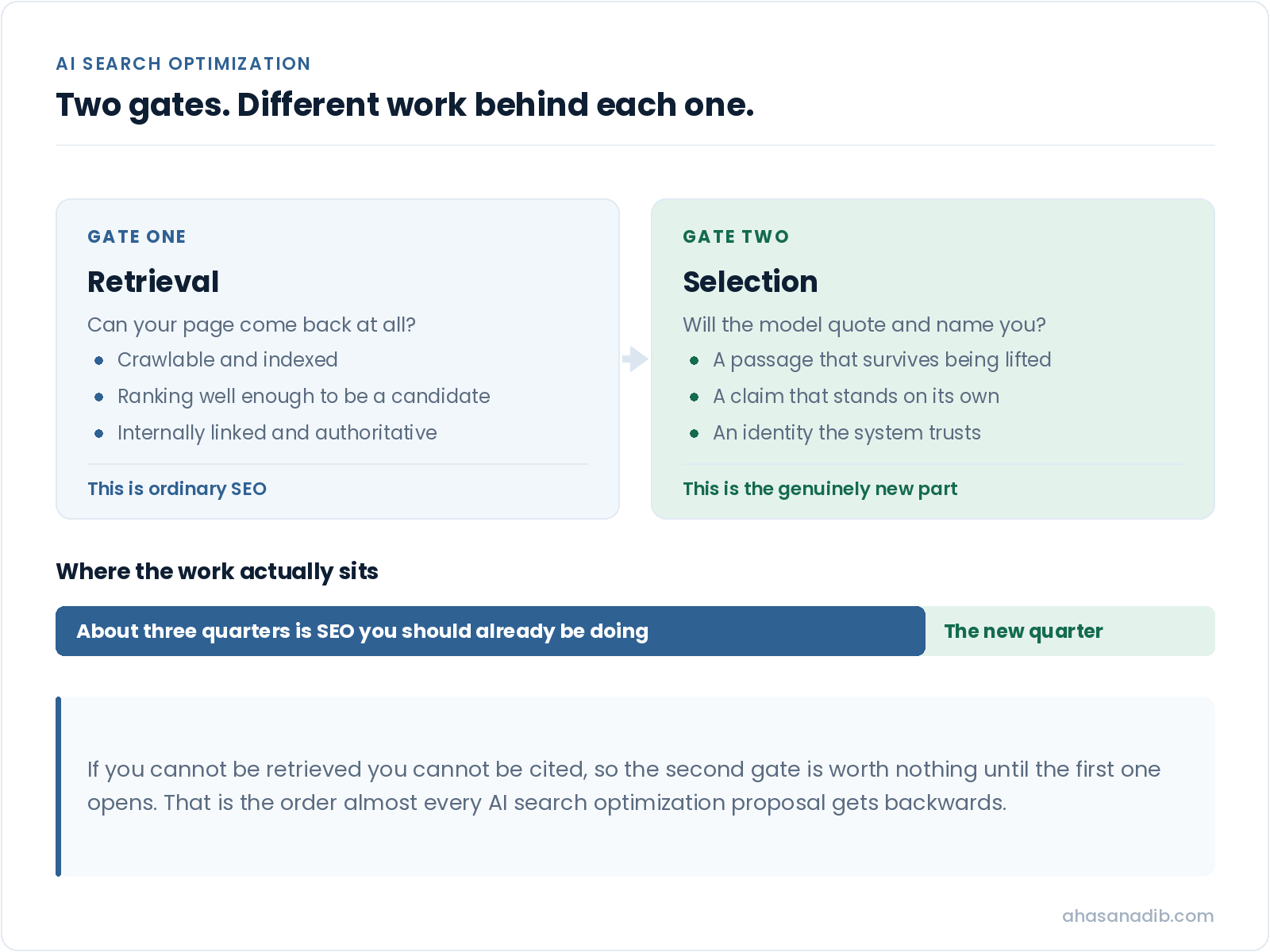
That structure has a direct consequence for you. There are two separate gates, and they are influenced by different things.
The first gate is retrieval. Your page has to come back in the candidate set for the query. For AI Overviews, that set is drawn from Google’s own index using Google’s own ranking systems, which is why Google’s own guidance on optimising for its generative features reads largely as a restatement of standard SEO advice. If you cannot be crawled, indexed and ranked, you cannot be retrieved, and nothing downstream matters.
The second gate is selection. Once several documents are retrieved, the model writes an answer and decides which sources to lean on and name. This is where the work genuinely differs from ranking, because the thing being chosen is not a page. It is a passage: a specific span of text that cleanly supports a specific claim.
Hold those two apart and most of the confusion in this field resolves. Retrieval is an SEO problem you already know how to solve. Selection is a writing and structure problem that most SEO habits do not address, and a few actively work against.
AEO, GEO, AIO and the rest of the acronym problem
Four terms, one and a half real distinctions.
The vocabulary here is a mess, and the mess is commercially useful to people selling separate services for each label. Here is the honest mapping.
Answer engine optimization, AEO, is the older term. It predates the current wave and originally meant optimising to be the direct answer: featured snippets, voice results, answer boxes. The goal is that your answer is shown, whether or not it earns a click.
Generative engine optimization, GEO, is the newer one, and it is the only one with actual research behind it. The term comes from an academic paper by Aggarwal and colleagues that framed the problem formally and tested which content changes improved a source’s visibility inside generated answers. If you only read one thing beyond this page, read the original GEO paper, because the entire industry is named after it and almost nobody selling GEO services cites it. Its practical finding, broadly, is that adding citations, direct quotations and statistics to a page improved how often and how prominently generative engines used that source. Note what that is: editorial changes to the text, not technical tricks.
AI search optimization, the term you probably arrived here on, is the umbrella. It covers both of the above plus visibility inside ChatGPT, Perplexity, Copilot and AI Overviews.
LLM optimization, AIO, and the rest are mostly rebrands. If someone is selling you these as four distinct services with four line items, ask what work differs between them. The honest answer is that they overlap almost entirely.
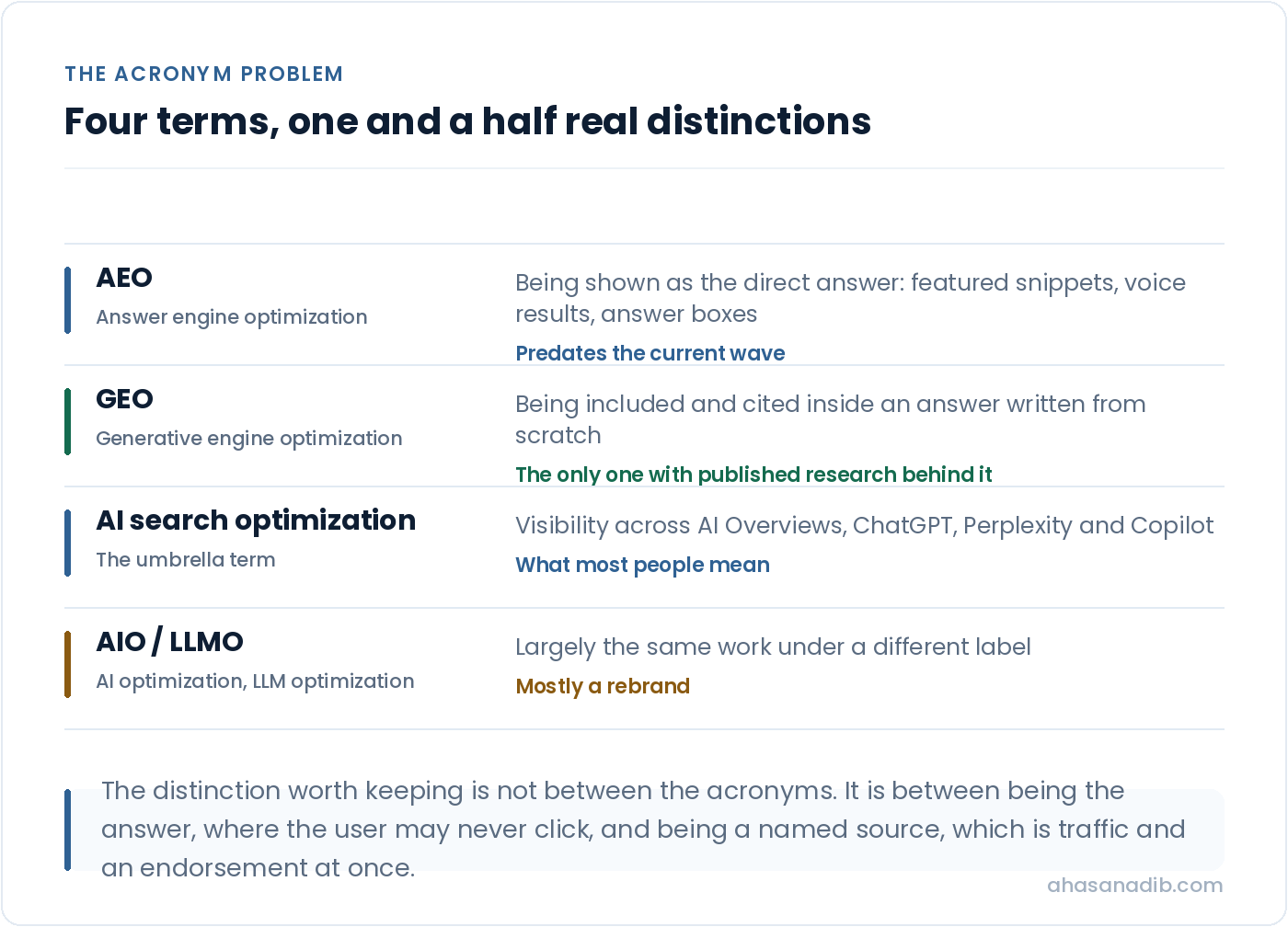
There is one distinction worth keeping, and it is not between the acronyms. It is between being the answer and being a source. Being the answer means the system states your content and the user may never click. Being a source means you are named and linked, which is both traffic and an endorsement. The second is worth considerably more, and it is what you should actually be optimising for.
How an AI answer gets built, and where you can influence it
Four stages, and you have leverage over three of them.
Walking the pipeline is the fastest way to see which tactics are real.
The query gets interpreted first, and frequently decomposed. A single question becomes several sub-queries covering its parts, which is why AI answers often blend sources that no single search would have returned together. You have no direct control here, but it explains something useful: your page does not need to answer the whole question. It needs to answer one part of it exceptionally well.
Then retrieval runs against an index. For AI Overviews that is Google’s index. For others it is a mix of their own crawling, licensing deals and partner indexes. Your leverage here is entirely conventional: crawlability, indexation, internal linking, and the authority that decides whether you surface for a competitive query at all. This is the stage where a site that cannot rank simply cannot participate, whatever it does to its content.
Next comes grounding and selection. The model reads the retrieved documents and constructs an answer from spans of them. This is the stage the GEO research addressed, and where your leverage is editorial: how cleanly your page states a claim, whether the claim is self-contained, whether it carries a figure or a quotation that is worth lifting.
Finally citation. The system attaches sources to the answer, and not every retrieved document gets named. Corroboration matters here, because a claim that appears in one place is riskier to cite than one supported across several independent sources. This is the stage where your entity footprint and your mentions elsewhere start to matter more than your on-page work.
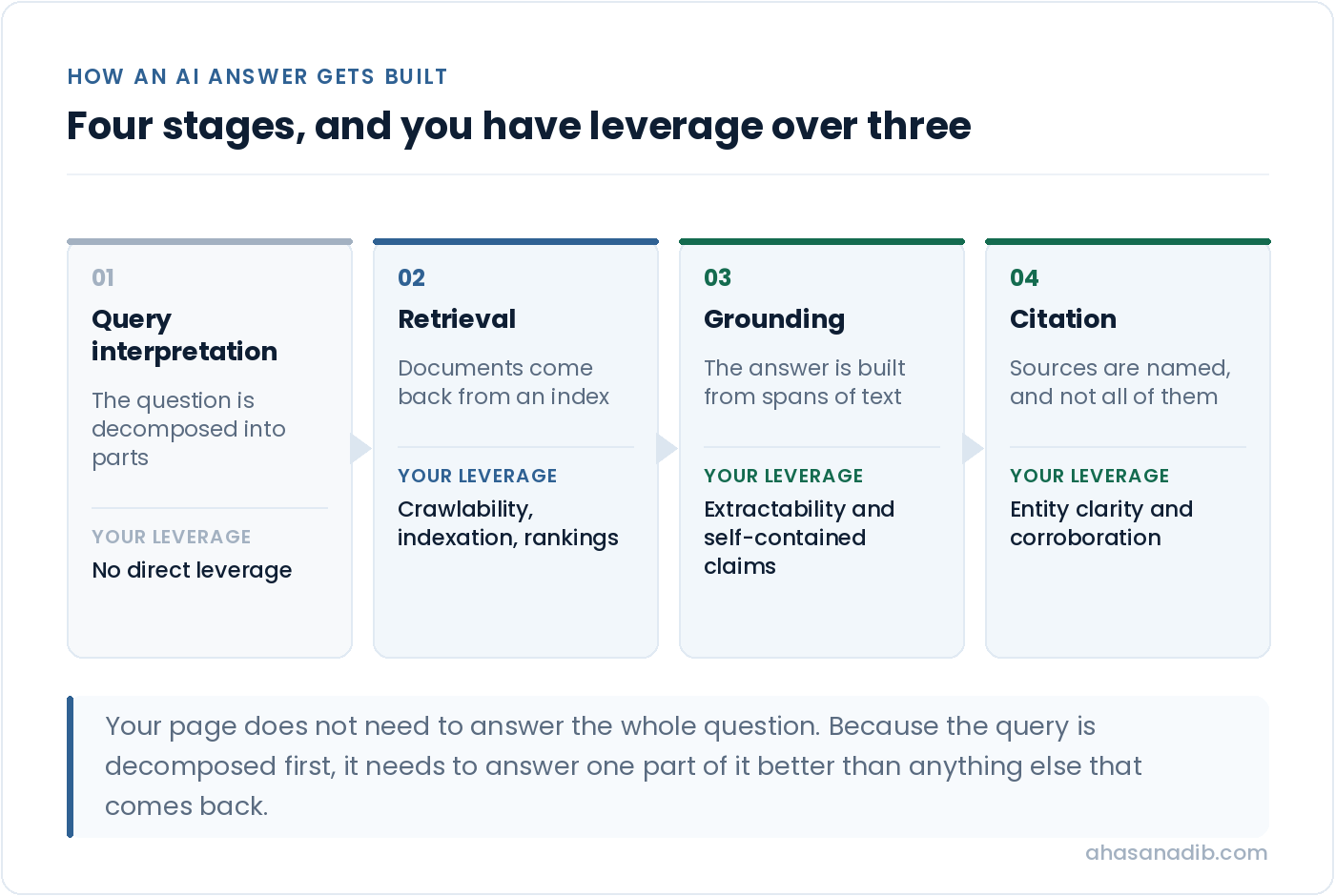
The practical read: stages two and three are where most sites have room to improve, and stage four is why AI visibility is not a purely on-page discipline no matter how it is sold.
What is genuinely new, and what is repackaged SEO
The split nobody selling this wants to publish.
Here is my honest division after doing this work, and it is not flattering to the category.
Repackaged, meaning you should already be doing it and it happens to help AI visibility: crawlability and indexation, site speed, clean information architecture, internal linking, structured data, topical coverage, and earning links and mentions. If a proposal for AI search optimization is mostly these items with a new label on the invoice, you are buying technical SEO at a premium.
Genuinely different, meaning ordinary SEO habits do not produce it, and some work against it:
Extractability. A passage that can be lifted whole and still make sense. Most SEO-shaped writing is the opposite: long throat-clearing before the answer, pronouns pointing back at earlier paragraphs, claims split across three sentences. A model looking for a clean span finds nothing liftable.
Self-contained claims. If your key sentence needs the previous paragraph to make sense, it cannot be quoted. Writing each important claim so it survives being removed from its context is a specific discipline, and it feels slightly repetitive to write. Do it anyway.
Entity clarity. The system has to be confident about who you are before it will name you. That is schema, consistent naming, a real About page, and being described the same way in enough places that the identity resolves. This is the part most sites are weakest on and the part that takes longest to fix.
Corroboration. Being said about you elsewhere. You cannot write your way to this, which is precisely why it is undersold: it is the one input a content retainer cannot manufacture.
Question-shaped structure. Headings that match how people ask, with the answer immediately underneath. This overlaps with old featured-snippet practice, which is why AEO practitioners had a head start.
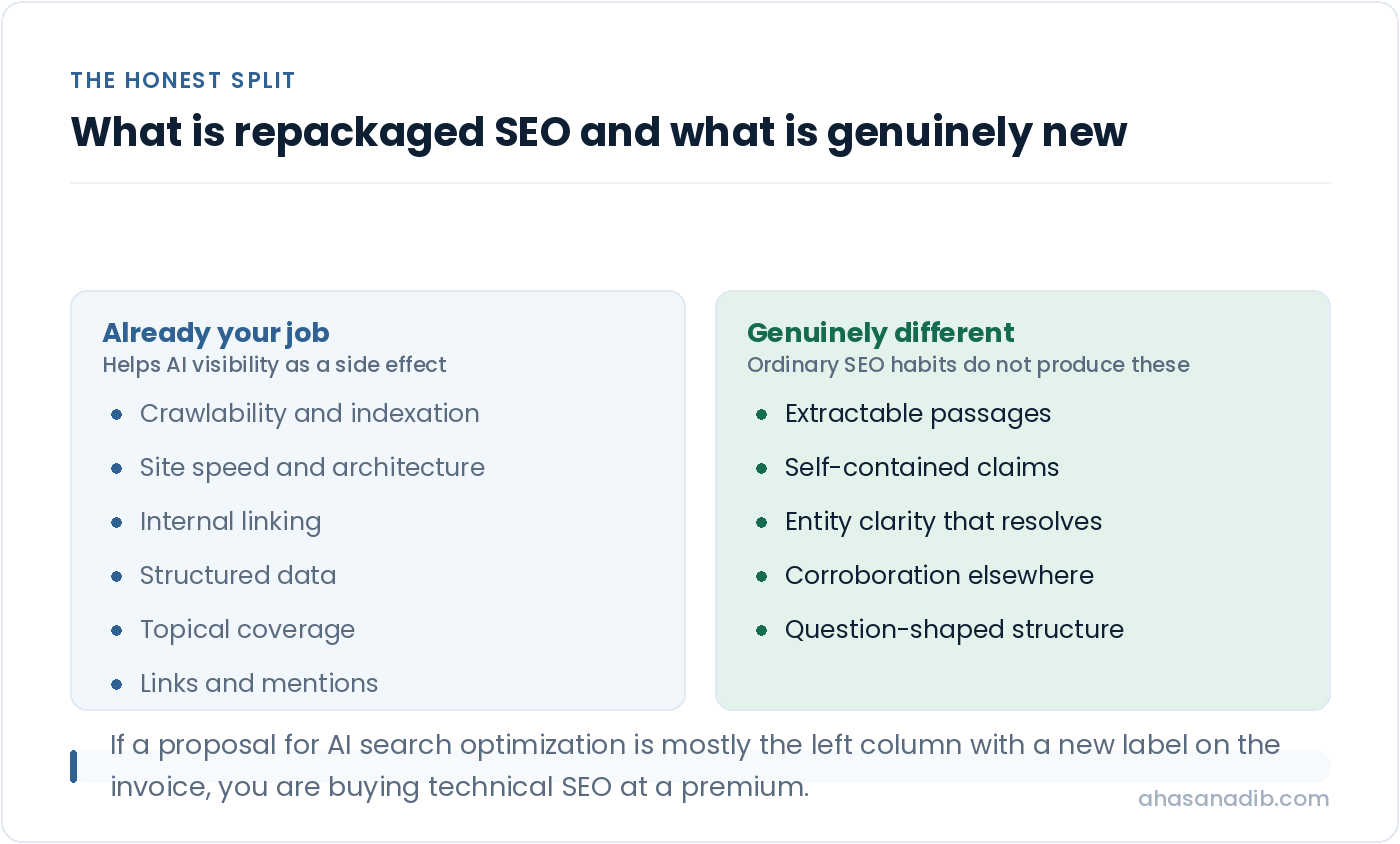
Add it up and the genuinely new portion is real but modest. It is a meaningful quarter of the work, sitting on top of three quarters you should have been doing regardless.
What actually moves AI visibility
In the order I would work through them.
Fix retrieval first, because it gates everything. If your important pages are not indexed, or are indexed but rank on page four, no amount of answer-shaped rewriting will get you retrieved. This is ordinary technical SEO, and it is where I start on every engagement regardless of what the client thought they were buying.
Then restructure your highest-intent pages for extraction. Lead each section with the claim rather than building to it. Keep the sentence that answers the heading directly under the heading. Make definitions definitional. This costs nothing but attention and it is the single highest-return editorial change available.
Add the things the GEO research found helped: real statistics with their source named, direct quotations, and citations to authoritative work. Note the honest reading of that finding. Pages that cite sources and carry verifiable numbers get used more, which is a reasonable thing for a system optimising for factual grounding to prefer. It also happens to describe good writing.
Strengthen the entity. Consistent name, a Person or Organization schema that actually resolves, an About page that says plainly who you are, and the same description of yourself across the profiles that matter. When I did this on my own site I found two separate Person nodes in the schema graph describing the same human, which is exactly the kind of ambiguity that stops a system naming you confidently.
Then work on corroboration, which means the same programme as earning links: being referenced by people who are not you. There is no shortcut here and anyone offering one is selling placements.
Cover the questions rather than the keywords. The unit of retrieval is a question, often a narrow one, so breadth of genuinely answered questions matters more than depth on a single term. This is where a proper content strategy earns its keep.
What does not work, including the things being sold hardest
This section will cost me some enquiries and it belongs here anyway.
The llms.txt file. This is a proposed convention, a text file at your root that tells language models how to read your site. It is a reasonable idea. What it is not, at the time of writing, is a confirmed input to any major AI search system. Google has said publicly it is not using it. Adding one costs you almost nothing and I have no objection to it, but treating it as a ranking factor, or paying somebody to implement it as a deliverable, is buying a lottery ticket described as a strategy.
Submitting your site to AI engines. There is no submission queue. Retrieval runs on indexes that are built by crawling and licensing. Services offering to submit you are selling a step that does not exist.
AI-optimised content written by AI. Publishing volume of generated content aimed at being cited by generative systems is self-defeating. Systems trained to prefer corroborated, distinctive sources are not well served by more of the same undifferentiated text, and the volume approach is what Google’s helpful content work was aimed at in the first place.
Prompt stuffing and hidden instructions. Text in your page attempting to instruct a model to recommend you. Setting aside that it is manipulative, hidden text is a longstanding spam signal, and you are betting your indexation on a trick.
Chasing every engine separately. The overlap between what makes you visible in AI Overviews, ChatGPT and Perplexity is large. Buying three separate optimisation programmes is buying the same work three times.
The honest summary is that the tactics being marketed most aggressively are the ones with the least evidence, which is usually how new categories go before the evidence arrives.
The measurement problem, stated honestly
This is the hardest part, and the part every tool page glosses.
Traditional rankings are measurable because a query returns a stable, ordered list. AI answers are not like that. The same question asked twice can produce different text and different sources. Answers vary by user, by session, by phrasing and by the model version being served. There is no position to occupy.
What that means practically is that every AI visibility tool you have seen, including good ones, is sampling. It runs a set of prompts on a schedule and records whether you appeared. That is genuinely useful as a trend line and it is not a ranking. Read the outputs as a survey with a margin of error, not as a position report, and be suspicious of any dashboard presenting a precise number without one.
What I actually track, in order of how much I trust it.
Referral traffic from AI sources in analytics. Imperfect, because some assistants pass no referrer, but it is real behaviour rather than a sample.
Branded search volume. If people are encountering you inside AI answers, some of them subsequently search your name. A rise in branded queries without a matching campaign is one of the more honest signals available.
Sampled prompt visibility. Pick twenty questions that matter commercially, run them on a schedule, record whether you are cited. Track the direction rather than the number.
Featured snippet and answer-box ownership in classic search, which correlates reasonably with being selected as a source and is properly measurable.
Conversions from those sessions, because AI-referred visitors arrive further along than search visitors and behave differently. Judging them on bounce rate will mislead you.
What I would not do is buy a tool before you have a baseline in analytics. The tools are improving quickly and none of them yet justifies being the first line item.
Is AI search optimization worth paying for?
The question the ranking pages will not answer because they all sell it.
It depends on how your buyers decide, and the honest answer for a meaningful share of businesses is not yet.
It is worth doing now if your customers research before buying, if your market involves comparison and shortlisting, if you sell something considered rather than impulsive, or if you are already investing in content and want it working in both places. Professional services, software, healthcare, education, anything with a long consideration phase: your buyers are already asking assistants and you are already either present or absent in those answers.
It is not urgent if you are a local business whose customers search on their phone and call the top result, if you compete mainly on price or proximity, or if you have no content programme to build on. A restaurant does not need generative engine optimization. It needs a correct Google Business Profile.
And it is premature, whatever your market, if your site is not yet ranking. This is the case I see most often and the one where I turn work down. If you cannot be retrieved, optimising for citation is optimising a stage you never reach. Fix indexation and rankings first; the AI visibility largely follows, because the retrieval layer is the same.
On budget, the reasonable position is that this should be a component of an SEO programme rather than a separate line item at a premium. When it is priced separately for work that is eighty per cent conventional, you are paying for the label. That is my own view and it is worth weighing against the fact that I am also selling the service, on the AEO and GEO page, where the same reasoning is set out with the pricing attached.
AI search optimization FAQs
How do I optimize for AI search?
Work in two stages. First make sure you can be retrieved: crawlable, indexed, and ranking well enough to enter the candidate set, which is ordinary technical SEO. Then make your content easy to cite: lead sections with the claim, write self-contained sentences that survive being quoted out of context, include verifiable statistics and named sources, and make your identity unambiguous through schema and consistent naming. Retrieval is the gate and citation is the prize.
Is AI search optimization different from SEO?
Partly. Roughly three quarters of it is technical and editorial SEO you should already be doing, because AI systems retrieve from conventional indexes. The genuinely different quarter is extractability, self-contained claims, entity clarity and corroboration. Anyone describing it as an entirely new discipline is selling a label.
Does llms.txt help with AI search visibility?
There is no evidence that it does. It is a proposed convention rather than a confirmed input, and Google has said it is not using it. Adding one is cheap and harmless. Paying for it as a deliverable, or treating it as a ranking factor, is not supported by anything currently observable.
How do I measure AI search visibility?
Accept that you are sampling rather than measuring a position, because AI answers vary between sessions and users. Track referral traffic from AI sources, branded search volume, a fixed set of commercially important prompts checked on a schedule, and featured snippet ownership as a measurable proxy. Treat any tool presenting a precise AI ranking as a survey result, not a position.
What is the difference between AEO and GEO?
AEO is the older term and means being the direct answer, including featured snippets and voice results. GEO is newer, comes from an academic paper, and means being included and cited inside answers generated from scratch. In practice the work overlaps heavily, and being sold them as separate services is a pricing decision rather than a technical one.
Will AI search kill SEO traffic?
It is reducing clicks on informational queries where the answer can be given without a visit, and that trend is real. It is affecting commercial and transactional queries far less, because people still want to see, compare and buy from a page. The practical response is to weight your content towards queries where a click is still necessary, and to accept that some informational traffic is not coming back.
Can a new website get cited in AI answers?
It is harder, for the same reason a new site struggles to rank: retrieval favours established sources, and citation favours corroborated ones. A new site with genuinely original data can be cited faster than its authority would suggest, because original information has nowhere else to be retrieved from. Publishing something nobody else has is the shortest route.
Where I would start
Three things, in this order.
Check whether you are retrievable at all. Take the ten questions that matter commercially and look at whether your pages rank on page one for them in ordinary search. Where they do not, that is your project, and it is a conventional SEO project.
Rewrite the openings of your most important pages so each section leads with its claim rather than arriving at it. This takes an afternoon per page, needs no tooling, and is the change most likely to get you quoted.
Fix your entity. One consistent name, schema that resolves, an About page that states plainly who you are and what you do. It is unglamorous and it is what decides whether a system is confident enough to name you.
Everything else on this page is worth doing after those three. If you want it handled alongside the search work it depends on, that is what my AEO and GEO service covers, and a technical audit is where I would start if the retrieval layer is the part that is broken.
Not sure whether this is your problem yet?
Bring your site to a free call. I will check whether you are retrievable before anything else, because if you are not, AI visibility work is optimising a stage you never reach, and I would rather tell you that than sell it.
Book a free call →