
A technical SEO expert is someone who works out why a website is not being crawled, indexed or ranked the way it should be, and fixes the cause rather than the symptom. That is a diagnostic job rather than a checklist job, and the gap between those two things is the entire reason the title exists.
I read the first page of results for this term before writing, because I do that before every piece. It is an unusual page one. There is a tool site ranking on its own brand name, two agency service pages, a freelancer marketplace, an agency roundup, a career guide written for people who want the job rather than people who want to hire one, and a page from a site with no authority whatsoever that ranks purely because it answers the question thoroughly.
Between them they define the role at considerable length. The longest runs close to seven thousand words. Not one of them tells you how to work out whether the person sitting in front of you is any good, what the work costs, or when you should not hire anybody at all. Google’s own related questions on this search include how much an SEO expert costs, and nothing on page one answers it with a number.
So this is the hiring guide rather than another definition. What the work actually is, why most audits are not diagnoses, the questions that separate a diagnostician from a tool operator, the warning signs, what it costs in real money, and the situations where I would tell you to wait.
The short version
- 1The job is diagnosis. Anyone can run a crawler. The expertise is deciding which of the three thousand flagged issues is costing you money, and being able to show why.
- 2An audit delivered as a colour-coded list of every issue on the site is inventory, not a diagnosis. Ask what they would fix first and why, and listen for whether the answer connects to revenue.
- 3You can judge technical skill without being technical yourself. Ask them to explain one finding on your own site in plain language, including how they would know afterwards whether the fix worked.
- 4Expect roughly £1,500 to £5,000 a month for ongoing work, or a one-off audit priced by the size and complexity of the site. Anyone quoting before they have looked at your site is quoting a template.
- 5If your site is small, sits on a mainstream platform and is already indexed, you probably need content and links rather than a technical specialist. Saying so costs me work and it is still true.
What a technical SEO expert actually does
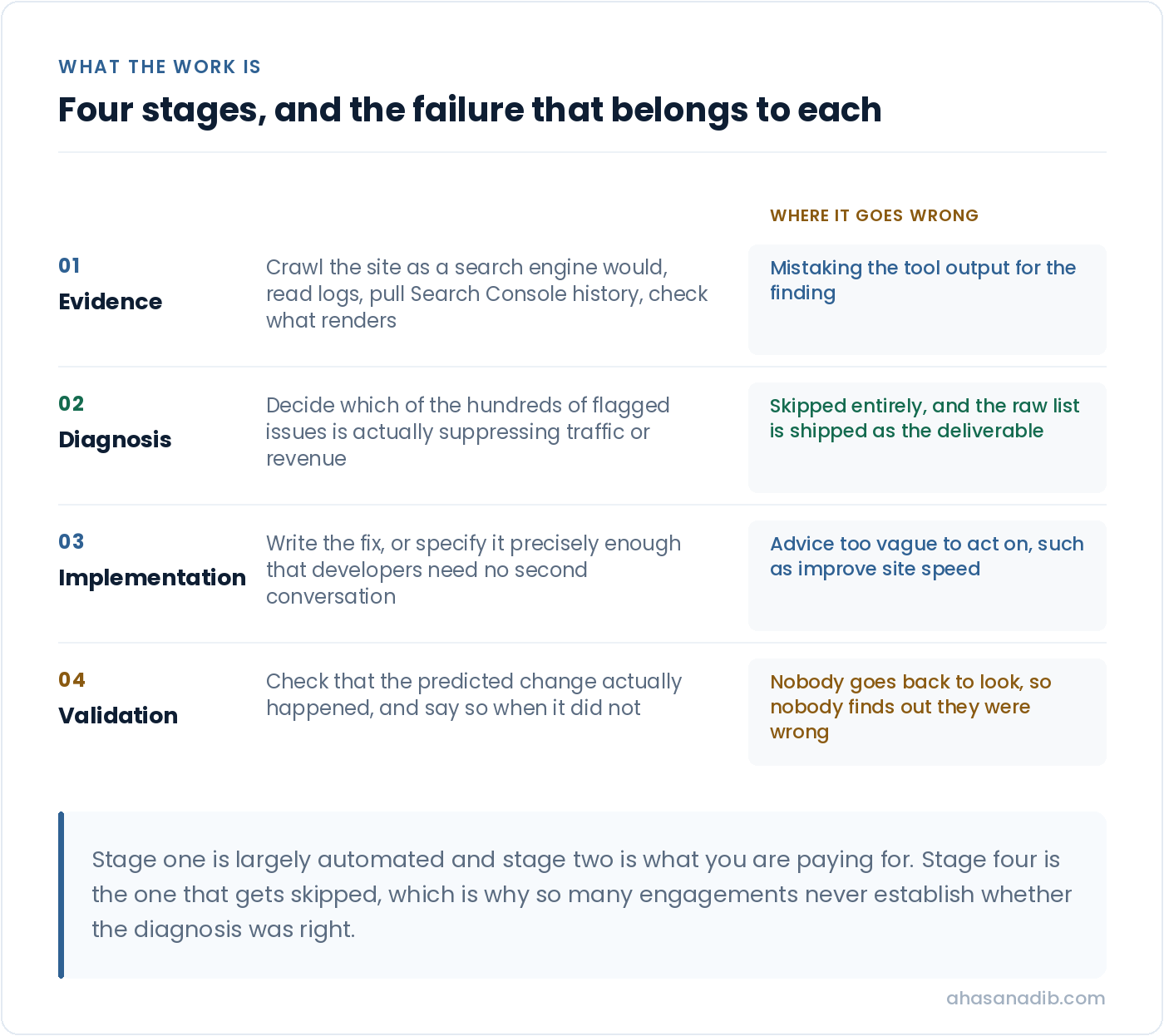
The work runs in four stages, and the stage where the value sits is not the one most people picture.
Evidence comes first. That means crawling the site the way a search engine would, reading server logs where they are available, pulling coverage and performance data from Search Console, checking how pages render when JavaScript is executed rather than how they look in the source, and comparing all of that against what the business believes is happening. This stage is largely mechanical. Tools do most of it, and the tools are broadly the same ones everybody uses.
Diagnosis comes second, and this is the part you are actually paying for. A mid-sized site will produce hundreds or thousands of flagged issues. The overwhelming majority of them do not matter. A handful are quietly costing real revenue. Telling those two groups apart requires knowing how search engines behave, how your specific platform behaves, and which of your pages carry commercial weight. No tool does this. It is judgement built on pattern recognition, and it is why two people can run the same crawl and produce completely different work.
Implementation comes third. Sometimes the specialist writes the fix, sometimes they specify it precisely enough for your developers to implement without a second conversation. Both are legitimate. What is not legitimate is a document that says to improve site speed and stops there.
Validation comes fourth and gets skipped constantly. Did the fix work? Did the pages get indexed, did the errors clear, did the traffic that was supposed to recover actually recover? A technical SEO expert who does not come back and check is a technical SEO expert who never finds out they were wrong.
How the role differs from a general SEO consultant
A general SEO consultant works across the whole discipline: keyword strategy, content, links, technical, measurement. A technical specialist goes deep on the layer underneath all of it. The distinction matters when you are hiring, because the two solve different problems. If your pages are indexed and ranking on page two, a technical specialist is probably not your answer. If half your product pages are missing from Google entirely, a content strategist is definitely not your answer.
Most sites need both at different times. Very few need both at once, and being sold both at once is a common way to spend money on the half that was not the constraint. If you are still working out which one your problem calls for, I have set out what a general SEO consultant actually does and where the time goes.
How the role differs from a developer
This one causes real confusion, because the work touches code. A developer builds and maintains the site. A technical SEO expert understands how search engines interpret what the developer built, and translates between the two. The overlap is genuine but partial. Plenty of excellent developers ship sites that cannot be crawled properly, not through incompetence but because nothing in their job requires them to think about a crawler’s constraints. Equally, plenty of technical SEO specialists can identify a rendering problem precisely without being able to fix it themselves.
The practical implication when hiring: ask who will write the code. If the answer is your team, the specialist’s specification needs to be precise enough that your developers do not have to interpret it. That is a skill, and it is worth testing for.
Why most technical SEO audits are not diagnoses
This is the single most useful thing on this page, so I have put it early.
Here is what happens in most engagements. Somebody points a crawler at your site. The crawler produces a report listing every deviation from best practice it can detect: missing meta descriptions, images without alt text, headings out of order, links with redirects, pages with thin word counts. The report is exported, wrapped in a cover page, colour coded by severity, and delivered.
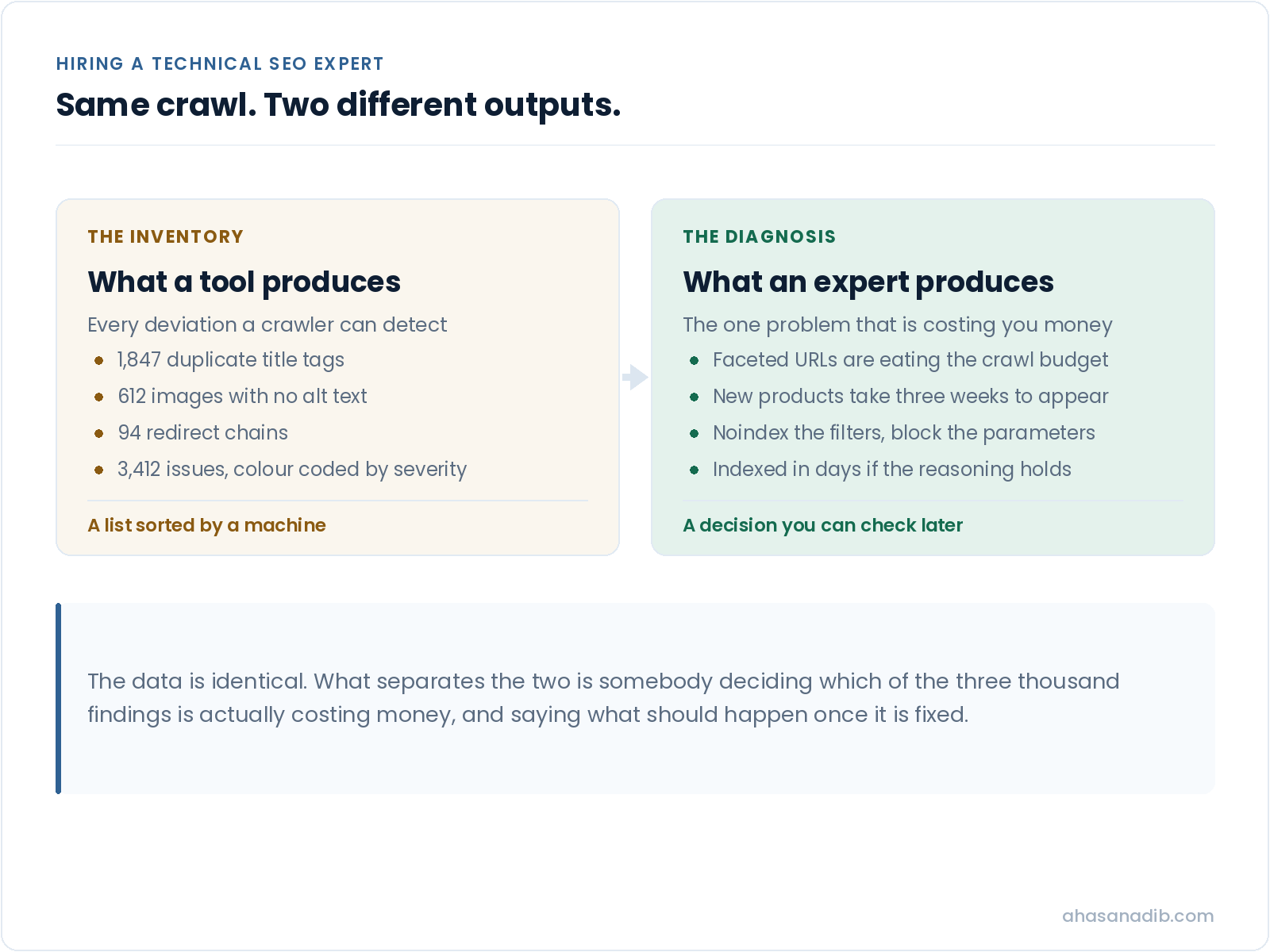
That document is an inventory. It is a list of everything a machine noticed. It is not a diagnosis, and the difference is not academic, because acting on an inventory means working through a list in the order a tool happened to sort it, which has no relationship to what is costing you money.
A diagnosis looks different. It names a problem, explains the mechanism by which that problem suppresses traffic or revenue, estimates the size of the effect, proposes a specific change, and states what should happen afterwards if the reasoning was correct. It is a short document. It is usually uncomfortable to write, because committing to a prediction means you can be shown to be wrong.
The tell is the length. A forty page audit on a two hundred page site is a sign that somebody exported a tool and formatted it. The genuinely useful version of that document is usually four or five pages, because most of what the crawler found was noise and somebody did the work of removing it.
An example of the difference
An inventory says: 1,847 pages have duplicate title tags.
A diagnosis says: your faceted navigation is generating a separate URL for every combination of filters, roughly 1,800 of them are indexable, and they are competing with your twelve category pages for the same terms. The crawl budget spent on those combinations is why new products take three weeks to appear in Google. The fix is to add a noindex directive to filtered views and block the parameter patterns in robots.txt. If this is right, you should see new products indexed within a few days rather than weeks, and the category pages should stop trading positions with filter URLs.
Same underlying data. One of them is a task; the other is a decision you can act on and later check. Google’s guidance on managing crawl budget on large sites makes the same point in its own way: the problem is rarely that a page is technically wrong, it is that attention is being spent where it does not pay.
When you evaluate anyone for this work, the question that separates the two approaches is simply what they would fix first, and why. A tool operator answers with a category. A diagnostician answers with a mechanism and a number.
How to judge a technical SEO expert when you are not technical
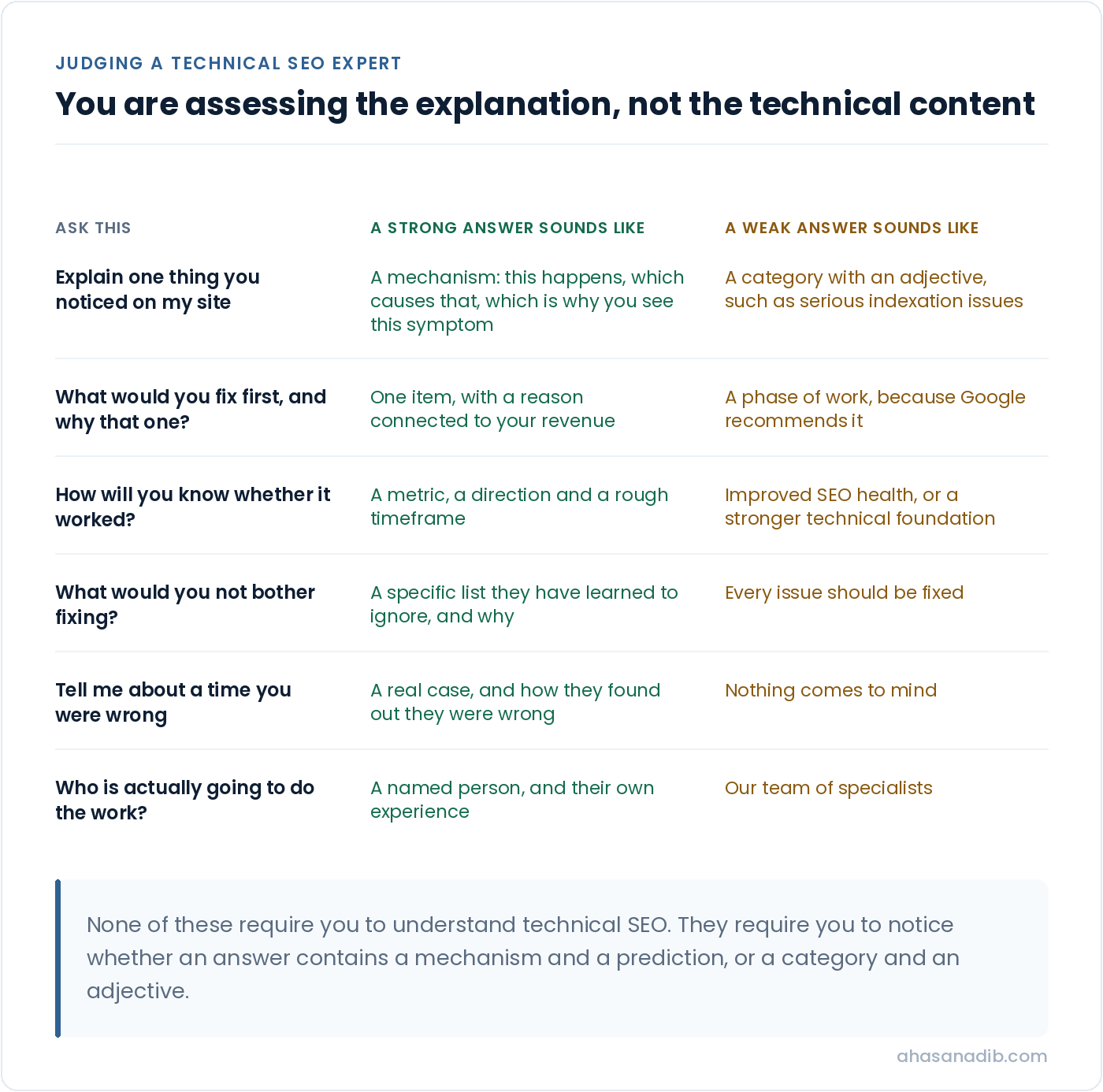
You do not need to understand the answers to evaluate them. You need to know what shape a good answer has.
This is the part every other page on this subject leaves out, and it is the part clients actually need. You are not being asked to assess whether a canonical implementation is correct. You are being asked to work out whether the person explaining it understands it. Those are different skills, and the second one is available to you.
Ask them to explain one finding on your site in plain language
Before any contract, ask for one specific thing they noticed about your site and an explanation you can follow. Someone who understands a problem can explain it without jargon. Someone who has read the output of a tool cannot, because the explanation is not actually in the tool.
A strong answer sounds like a mechanism: this happens, which causes that, which is why you are seeing this symptom. A weak answer sounds like a category with an adjective attached, such as your site has some serious indexation issues that need addressing. The second one is a sentence that could be said about any website ever built.
Ask what they would fix first, and why that one
The answer should be a single thing, not a phase. It should come with a reason connected to your business rather than to best practice. If the reason is that Google recommends it, that is a weak answer, because Google recommends a great many things and they are not equally urgent for you.
Ask how they will know whether it worked
This question does more work than any other. A good answer names a specific metric, a direction and a rough timeframe: indexed pages in Search Console should rise from about four hundred to about nine hundred within a month. A weak answer talks about improved SEO health or a better technical foundation, which are unfalsifiable by design.
Anyone unwilling to say what should happen is protecting themselves from being measured. That is worth noticing.
Ask what they would not bother fixing
I like this one because it is hard to fake. An experienced person has a long list of things that get flagged constantly and rarely matter on a given site: alt text on decorative images, a handful of redirect chains, a missing meta description on a page nobody lands on. Someone who says every issue should be fixed either has not developed judgement yet or is describing a larger invoice.
Ask about a time they were wrong
Technical SEO involves forming hypotheses about a system nobody fully documents. Anyone doing it seriously has been wrong, and the useful ones remember exactly how they found out. An answer with real texture here tells you the person validates their own work. No answer at all usually means stage four never happens.
Ask who is doing the work
At an agency, the person selling to you is frequently not the person who will open your crawl data. That is not automatically bad, and it becomes bad when it is concealed. Ask directly, and ask about their experience specifically, not the agency’s.
The warning signs
These are the ones I see most often, in rough order of how much they should worry you.
A price quoted before anyone has looked at your site. Technical work scales with the size and strangeness of the site. A number offered without a crawl is a number attached to a template, and the template will be applied to you regardless of what you needed.
Guaranteed rankings. Nobody controls Google’s results. A guarantee is either meaningless in the small print or is describing something manipulative that will eventually cost you more than it earned.
An audit as the entire deliverable, with implementation quoted separately and vaguely. A document nobody implements has produced nothing. The engagement should be clear from the start about who writes the code and when.
No questions about your business. Someone who does not ask which pages make you money cannot prioritise, because priority is a commercial judgement wearing technical clothes.
Deliverables measured in issues resolved. A report proudly stating that four hundred issues were fixed last month is measuring activity. Ask what changed in indexation, in rankings on pages that matter, in revenue.
Reluctance to talk to your developers. The work lands in somebody’s sprint eventually. A specialist who avoids that conversation is producing documents rather than outcomes.
Freelancer, agency or in-house
Every comparison of these you will read was written by somebody selling one of them, including this one, so here is where each is wrong.
I work as an independent technical SEO consultant, so treat what follows accordingly. I have tried to write the case against my own model as carefully as the case for it.
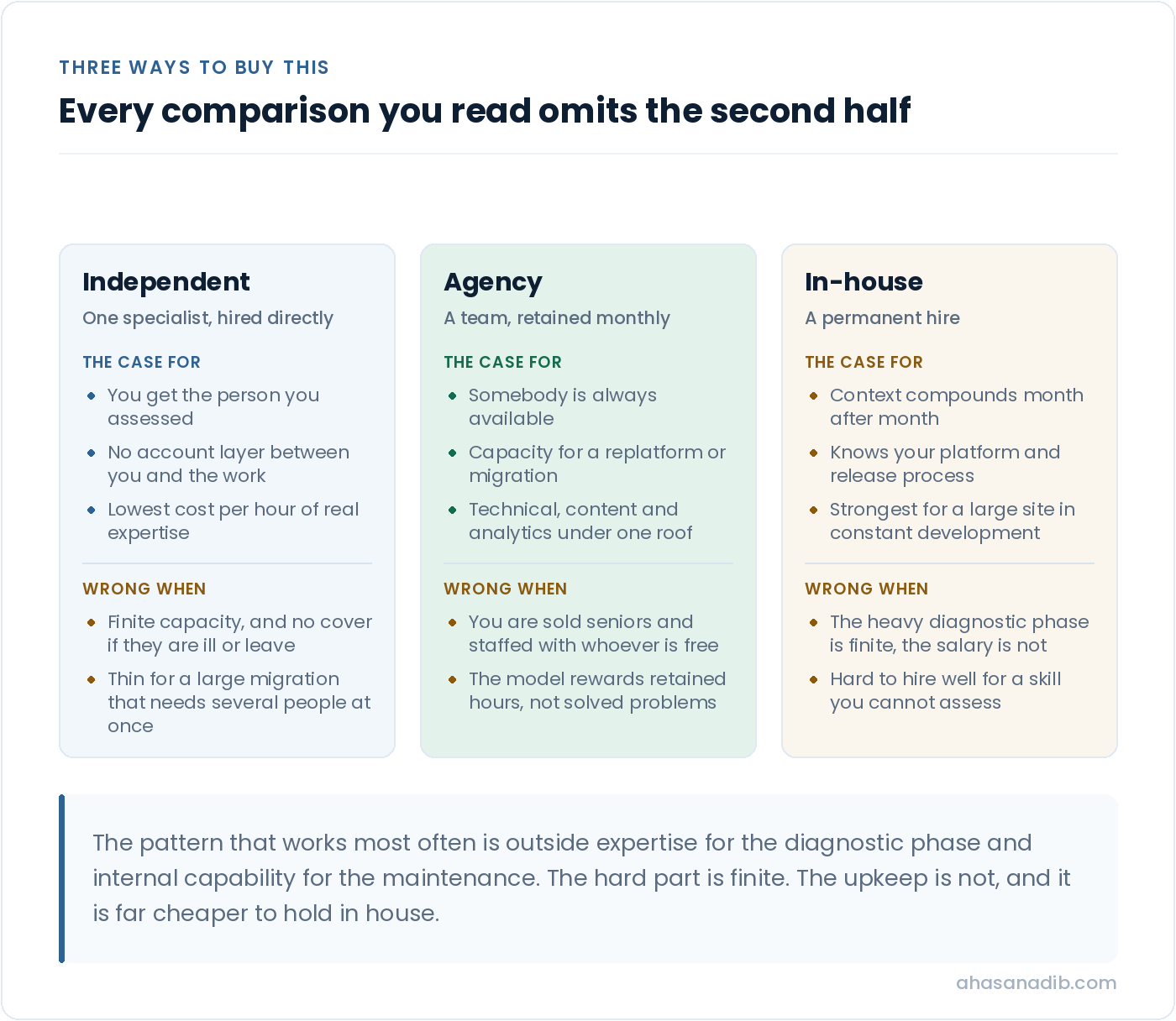
An independent specialist gives you the person you assessed. There is no account layer, no junior doing the work under a senior’s name, and decisions happen in one conversation. The cost per hour of genuine expertise is usually the lowest of the three because you are not funding overhead. Where this goes wrong is capacity and continuity. One person has a finite number of hours, cannot cover a large migration alone, and can be ill, oversubscribed or gone. If your site is business critical and you have no internal SEO knowledge at all, that concentration is a real risk and you should ask directly what happens if the person disappears. I set out how I handle that on my freelance SEO consultant page rather than repeating it here.
An agency gives you coverage. Somebody is always available, there is capacity for a large project, and the specialisms sit under one roof, which genuinely matters during a replatform when technical, content and analytics all move at once. Where agencies go wrong is the distance between the sale and the work. You are shown senior people and staffed with whoever is free. The commercial model rewards retained hours rather than solved problems, so engagements have a tendency to continue after the technical work is essentially finished. If you go this route, insist on meeting the person who will actually do the work, and agree what the end looks like.
An in-house hire gives you accumulated context. After a year, they know your platform, your release process and your commercial calendar better than any outsider will. That knowledge compounds and it is the strongest option for a large site with continuous development. Where it goes wrong is that technical SEO is spiky work. The heavy diagnostic phase is finite, and after it is done a full-time specialist frequently has more capacity than problems. It is also difficult to hire well for a skill you cannot assess yourself, which is how organisations end up with an expensive person nobody can evaluate.
The pattern that works most often, for what it is worth, is to bring in outside expertise for the diagnostic phase and to build internal capability for the maintenance. The hard part is finite. The upkeep is not, and it is much cheaper to hold internally.
What a technical SEO expert costs
Google’s related questions on this search ask exactly this, and nothing on page one answers it with a number, so here are mine.
I publish my rates for technical SEO services, which is unusual enough in this industry to be worth stating plainly. Ongoing work with me runs between £1,500 and £5,000 a month depending on the size of the site, how much implementation I am doing rather than specifying, and whether the engagement includes the wider search programme or the technical layer alone.
A one-off audit is priced from the site rather than from a menu, because a two hundred page brochure site and a forty thousand page catalogue with faceted navigation are not the same job in any respect. I quote after crawling, never before, and the crawl costs you nothing.
For the wider market, the honest ranges I see are these. Independent specialists tend to sit somewhere between £60 and £150 an hour, with monthly retainers commonly in the low thousands. Agencies typically start higher, often at £2,000 to £3,000 a month as a floor, and the enterprise end runs well beyond that. Marketplaces will show you day rates far below all of it, and at that end you are usually buying the crawler output described earlier.
Two things are worth knowing about how this is priced. The first is that technical SEO is front loaded. The diagnostic phase is the expensive part, and a well-run engagement should get cheaper after it, not settle into a permanent fee. If your invoice looks identical in month twelve to month one, ask what is being done with the money. The second is that hourly billing and this work fit together badly, because the value is concentrated in the judgement rather than the hours, and the fastest diagnosis is usually the most experienced one. That is why I price by scope rather than by hour across everything on this site.
When you do not need a technical SEO expert
Turning work down is cheaper for me than taking work that cannot succeed.
Technical problems are real and they are not universal. The cases where I would tell you to spend the money elsewhere are reasonably easy to recognise.
Your site is small and on a mainstream platform. A few hundred pages on current WordPress, Shopify or Webflow, with no custom rendering and no migration history, rarely has a technical problem large enough to be your constraint. Check that your pages are indexed. If they are, your problem is that not enough people link to you and not enough of your pages answer anything specific, and no amount of technical work fixes either.
Your pages are indexed and ranking on page two. That is a relevance and authority position, not a technical one. A specialist will find things to fix and you will not see the traffic move, because the thing holding you at position fourteen was never crawlability.
You have no capacity to implement anything. This is the one I turn down most often. If your developers are booked for six months and there is no budget for outside implementation, an audit becomes an expensive document. Wait until somebody can act on it.
You are below average on a metric but the metric is not your problem. It is worth some perspective here. The 2025 Web Almanac, which analyses millions of sites from the HTTP Archive crawl, found that only 48 per cent of mobile pages achieved good Core Web Vitals scores and that around a third of pages still carry no canonical tag at all. Being imperfect on these puts you in the company of most of the web, including plenty of sites that outrank you. A metric being red is not the same as a metric being the reason.
What genuinely does justify hiring one: a traffic fall you cannot explain, a migration in progress or recently completed, pages missing from the index in numbers, a large catalogue where new products take too long to appear, a JavaScript framework where you are unsure what search engines actually see, or a site that has grown to a size where nobody understands the URL structure any more.
What the first ninety days should look like
If you do hire someone, here is a reasonable shape to expect, and a way to tell early whether it is going well.
The first two weeks are evidence and diagnosis. Crawl, log analysis where logs exist, Search Console history, rendering checks, and a conversation about which pages carry commercial weight. What you should receive at the end is short: the problems that matter, ranked, with the mechanism explained and a prediction attached to each.
Weeks three to eight are implementation, starting with the highest impact item rather than the easiest. Expect specifications precise enough for your developers, and expect to be told when something needs a decision from you rather than from them.
Weeks eight to twelve are validation and the second pass. Did the indexation numbers move in the direction predicted, did the errors clear, did the traffic on affected templates respond. This is where you find out whether the diagnosis was right, and where an honest specialist tells you which of their predictions did not hold.
The early warning sign is simple. If, at the end of the first month, you have a large document and no changes deployed, the engagement has drifted into documentation. Say so then rather than at month six.
Technical SEO expert FAQs
What does a technical SEO expert do?
They diagnose and fix the reasons a site is not being crawled, indexed or ranked as it should be. In practice that means gathering evidence through crawls, log files and Search Console, working out which of the many detectable issues is actually suppressing traffic, specifying or implementing the fix, and then verifying that the predicted improvement happened. The diagnostic step is the one that carries the expertise, because the evidence gathering is largely automated and the fixes are often straightforward once the right problem has been identified.
How much does a technical SEO expert cost?
Independent specialists commonly charge between £60 and £150 an hour, with monthly retainers usually in the low thousands. My own ongoing work runs from £1,500 to £5,000 a month depending on scope, and one-off audits are quoted after crawling the site rather than from a price list, because a small brochure site and a large catalogue are entirely different jobs. Treat any quote given before somebody has looked at your site as a template price.
How do I find a good technical SEO expert?
Ask each candidate to explain one specific thing they noticed about your site in language you can follow, then ask what they would fix first and how they would know whether it worked. Strong candidates answer with a mechanism, a commercial reason and a measurable prediction. Weak candidates answer with categories and adjectives. You are assessing the quality of the explanation rather than the technical content, and that is something you can judge without being technical.
Is a technical SEO expert the same as a web developer?
No, although the work overlaps. A developer builds and maintains the site. A technical SEO expert understands how search engines interpret what was built and translates between the two. Many capable developers ship sites with crawling or rendering problems simply because nothing in their role requires them to think about a crawler’s constraints, and many technical SEO specialists can identify a rendering fault precisely without writing the fix themselves. When hiring, establish early who is going to write the code.
Do I need a technical SEO expert for a small website?
Usually not. A few hundred pages on a mainstream platform, with no migration history and no custom rendering, rarely has a technical constraint large enough to be the thing holding it back. Confirm your pages are indexed, and if they are, your limits are almost certainly authority and content depth rather than anything technical. Hiring a specialist at that point produces a list of small corrections and no traffic movement.
How long does technical SEO take to show results?
Indexation changes can appear within days to a few weeks, because you are changing what search engines are able to access. Ranking and traffic changes take longer, commonly one to three months, because the pages have to be recrawled, reassessed and then compete on their merits. Anyone promising a traffic response in days is describing either a very small fix on a very well-crawled site or something that will not last.
What should a technical SEO audit include?
A short ranked list of the problems that matter, each with the mechanism explained, an estimate of the commercial impact, a specific proposed change, and a statement of what should happen afterwards if the reasoning is right. What it should not be is an exported crawl of every deviation from best practice on the site, colour coded and bound. Length is a reasonable proxy here: forty pages on a small site usually means nobody did the work of removing the noise.
Where I would start
Three things, in this order, before you speak to anybody.
Find out whether you have a technical problem at all. Open Search Console, look at the pages report, and compare the number of indexed pages against the number of pages you believe you have. If those two numbers are close, your constraint is probably not technical and you have just saved yourself a retainer.
If there is a gap, write down what you think it is costing you. Which pages are missing, and are they pages that make money. This turns a technical curiosity into a brief, and it gives you the thing you need to judge whether a candidate’s priorities match yours.
Then ask two or three people the questions above, and compare the shape of the answers rather than the price. The gap between a diagnostician and a tool operator shows up in the first ten minutes if you know what to listen for, and it is a much larger gap than any difference in their quotes.
If you would rather have it handled, that is what my technical SEO service covers, and a standalone technical SEO audit is the right starting point when you need the diagnosis before you commit to anything ongoing. If the problem turns out to be visibility inside AI answers rather than conventional rankings, the same retrieval layer decides both, which I have written about separately on AI search optimization.
Not sure whether your problem is technical?
Bring your site to a free call. I will look at whether your pages are actually being indexed before anything else, because if they are, a technical engagement is not what you need and I would rather say so than sell you one.
Book a free call →