
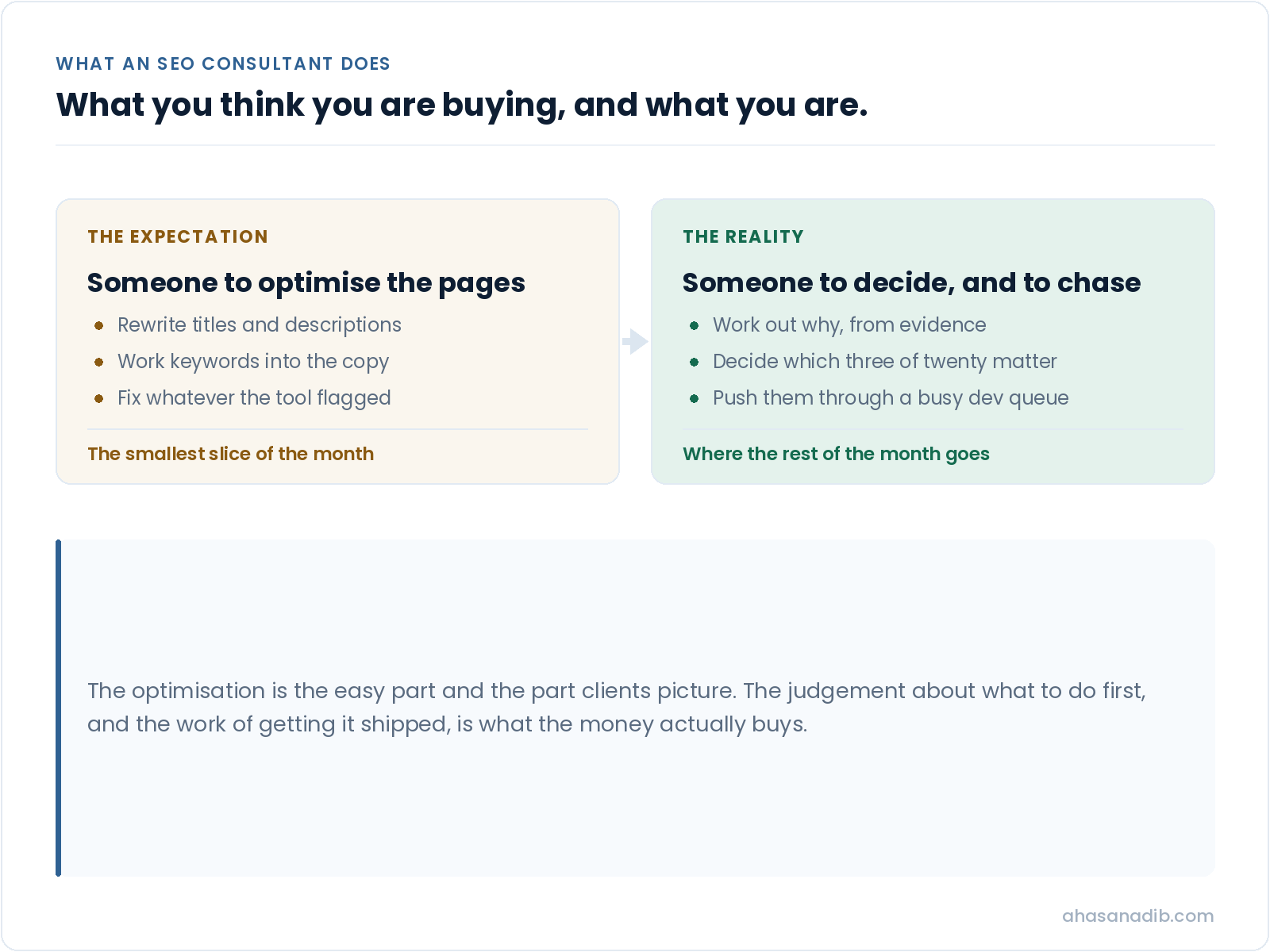
An SEO consultant works out why a business is not getting the search traffic it should, decides which fixes are worth the effort, and then spends most of the engagement getting those fixes actually implemented. The diagnosis is the skilled part. The implementation chase is the part that takes the hours, and almost nobody writing about this job mentions it.
I read page one for this question before writing. It splits into three kinds of page and none of them answers it properly.
There are career pages, written for people who want to become a consultant rather than hire one, which describe the role as a list of skills on a job advert. There are vendor overviews, one of which runs to about six hundred words and ends by recommending three agencies, the first of which belongs to the author. And at position two, above nearly all of them, there is a discussion thread on Reddit titled roughly what an SEO specialist really does, pulling more traffic than most of the commercial pages beneath it.
That thread is the tell. People asking what does an SEO consultant do are not being satisfied by the pages built to answer it, so they go looking for somebody unguarded. So here is the unguarded version from someone who does the job: where the time actually goes, what you should receive and when, what I can and cannot control, and the situations where hiring me would be a mistake.
The short version
- 1The job is roughly one part diagnosis, one part persuasion and one part waiting. Only a small share of the week is spent doing the thing most people picture, which is optimising pages.
- 2A consultant controls the diagnosis, the priority order and the quality of the specification. They do not control your development capacity, your competitors, or Google.
- 3The most common reason an engagement fails is not a bad diagnosis. It is a correct diagnosis that nobody had the capacity to implement.
- 4You should receive something you can act on every month, and a straight answer about whether last month’s changes worked. If month six looks like month one, the engagement has stalled.
- 5If your site is new, has almost no content, or nobody can make changes to it for the next quarter, a consultant is premature and I would tell you so.
The short answer, and why the honest one is longer
Ask ten consultants and you will get a version of the same list: technical audits, keyword research, content strategy, on-page optimisation, link acquisition, reporting. That list is accurate and it is close to useless, because it describes the categories of work rather than the job.
Here is the job as it actually runs. A business is not getting the traffic it expects. Somebody has to work out why, from evidence rather than habit. The reasons are usually not the ones anybody guessed. Then somebody has to decide which of the twenty things that are wrong are the three worth doing first, which is a commercial judgement rather than a technical one. Then somebody has to get those three things through a development queue, a marketing calendar and a stakeholder who has a different priority. Then somebody has to check whether it worked and say so out loud.
Notice how little of that is optimisation. The optimisation is the easy part. Google’s own guidance on whether you need an SEO at all is unusually candid on this point, and it is worth reading before you hire anybody, including me.
Where the time actually goes
This is the section every other page on this question leaves out.
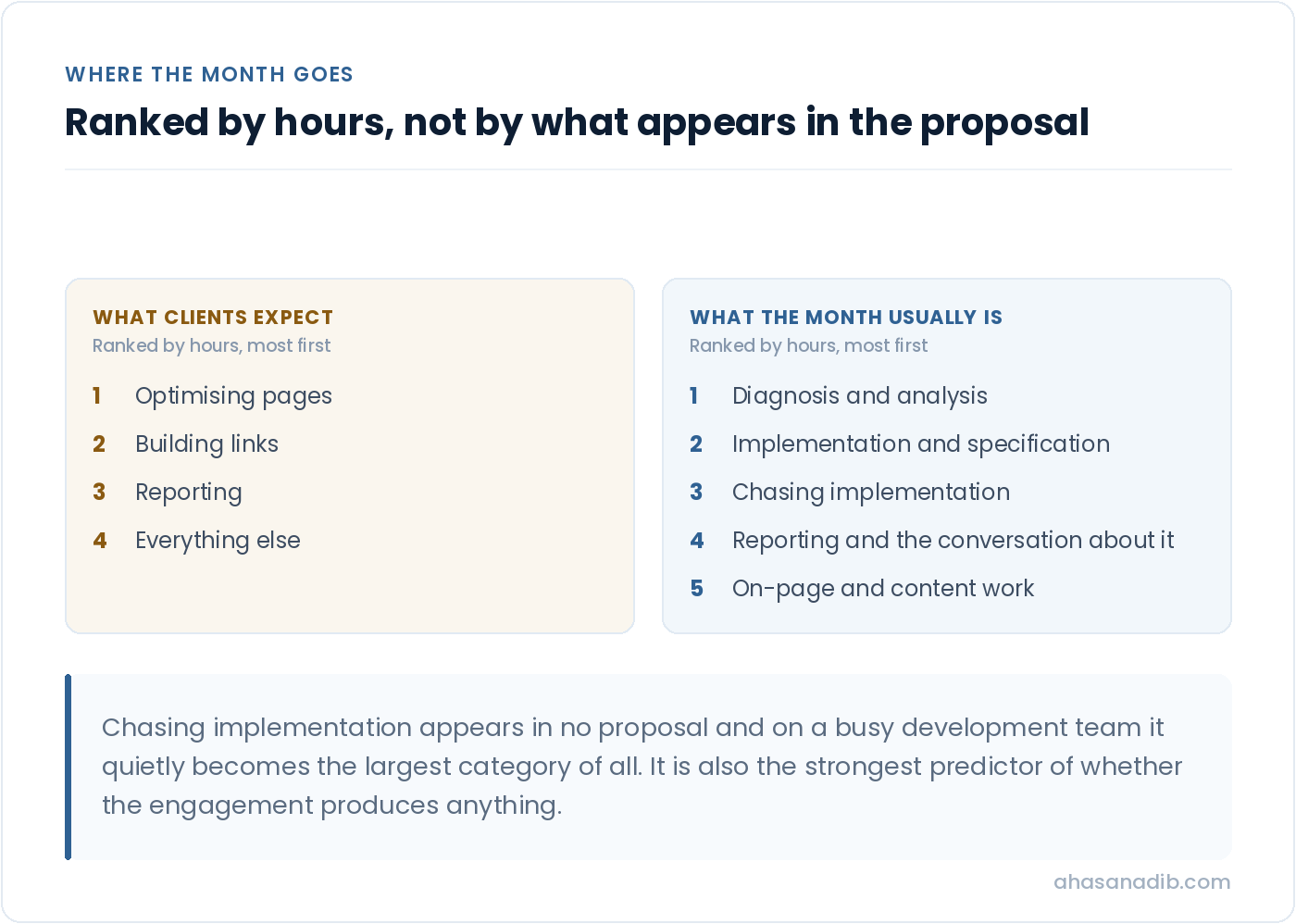
If you tracked a month of my working hours on a typical client, the split looks roughly like this, and it surprises people.
Diagnosis and analysis takes the largest single share. Crawling, reading Search Console, pulling apart what competitors are doing differently, working out which pages carry commercial weight and which are decoration. This is where the value is created, and it is largely invisible to the client because the output is a short document rather than a long one.
Implementation and specification comes next. Writing the fix myself where I can, and where I cannot, writing an instruction precise enough that a developer who has never thought about crawlers can execute it without a follow-up conversation.
Then a category that no proposal ever lists: chasing. Following up on the ticket that did not get picked up, re-explaining why the fix matters to somebody new, waiting for a release window, and finding out that the change went live but was implemented slightly differently in a way that broke the point of it. On a client with a busy development team this can quietly become the largest category of all, and it is the single biggest predictor of whether an engagement produces results.
Reporting and communication takes a real share, and should. A monthly document nobody reads is waste, but the conversation about what the numbers mean is usually where the next month’s priorities get set.
Actual content and on-page work is the smallest slice on most engagements, which is the exact opposite of what clients expect when they sign. When somebody tells me they want a consultant to optimise their pages, I know we are going to have a conversation in week three about why I have spent most of the month on their information architecture instead.
What a week actually looks like
Categories are abstract, so here is the shape of a real week on an established engagement.
Monday is data. What moved, what broke, what got indexed, what dropped. Most weeks nothing dramatic happened, and noticing that nothing dramatic happened is itself the job, because the alternative is reacting to noise.
Midweek is the deep work. One problem, properly investigated, until I understand the mechanism rather than the symptom. This is the part that cannot be rushed and the part that gets squeezed first when a client wants weekly updates full of activity.
There is a call, usually. The useful ones are about a decision. The less useful ones are about reassurance, and I have learned that a client asking for reassurance every week is usually telling me they do not understand the plan, which is my failure rather than theirs.
Thursday and Friday are handover and follow-up. Writing specifications, answering developer questions, checking what shipped, and updating the priority list based on what actually happened rather than what was supposed to.
What is missing from that week is a large volume of visible output, and that is the honest tension in this job. A consultant producing an impressive amount of documentation every week is usually producing documentation instead of results.
What an SEO consultant can and cannot control
Not one page ranking for this question addresses this, and it is the thing that decides whether you are happy in month six.
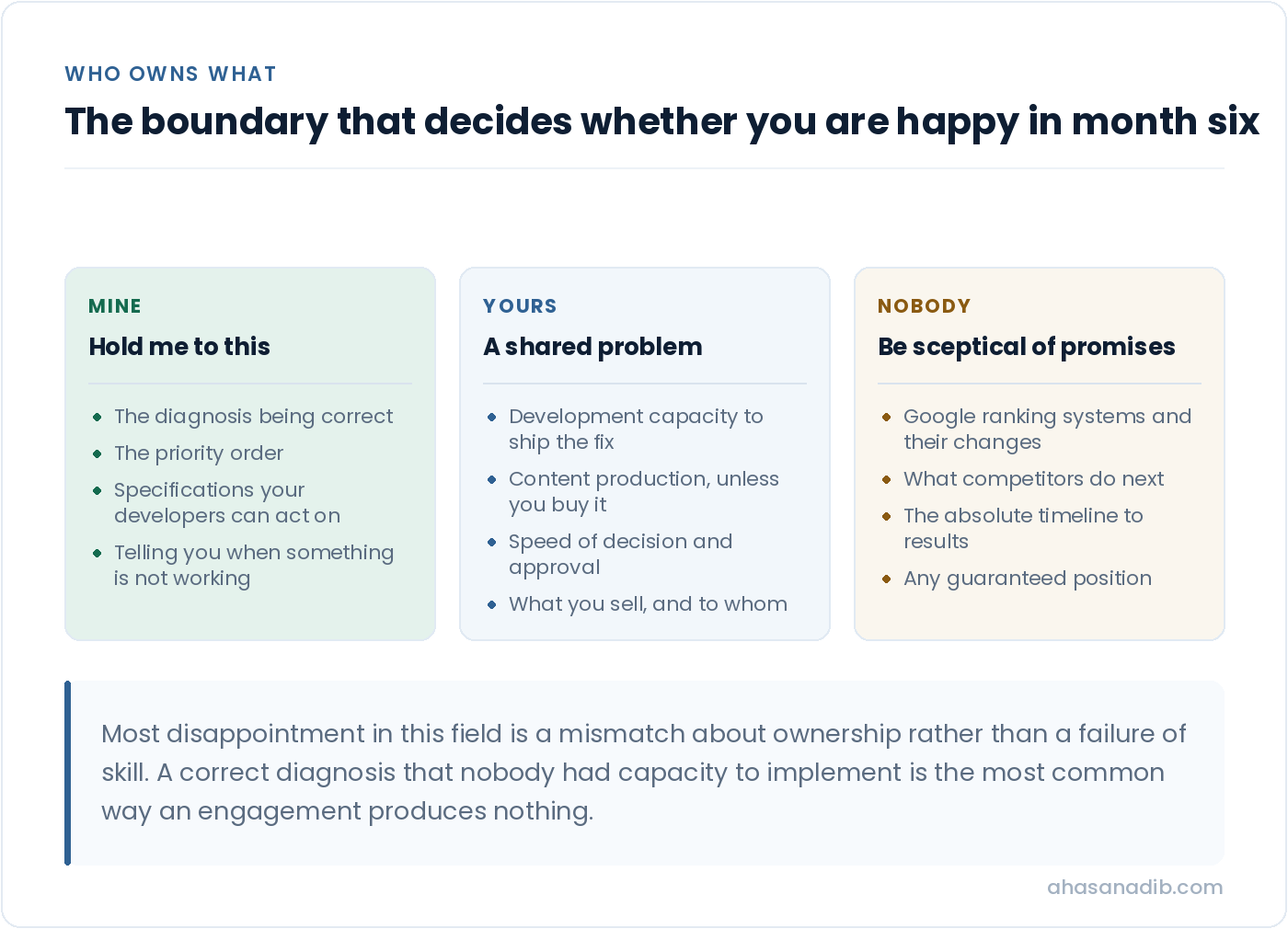
Most disappointment in this field comes from a mismatch about ownership. You think you have hired somebody to deliver rankings. What you have actually hired is somebody to make correct decisions about a system none of us controls. Those are different purchases and it is worth being explicit about the boundary.
What is genuinely mine
The diagnosis. If I misread why your traffic fell, that is my error and no circumstance excuses it. The priority order, because deciding what matters most is the judgement you are paying for. The quality of the specification, meaning whether your developers can act on what I hand them without guessing. Whether I tell you the truth when something is not working, including when the something is my own recommendation. And whether I know what I am doing, which sounds obvious until you meet the number of people selling this who do not.
What is genuinely yours
Development capacity. I can specify a fix perfectly and it changes nothing until somebody deploys it. Content production, unless you are paying me to write, and most people are not. Commercial decisions about what you sell and to whom, which set the ceiling on what any amount of search work can achieve. Speed of decision, because an approval that takes five weeks costs five weeks. And budget, which is not a moral matter but is a real constraint on what is possible.
What belongs to nobody
Google’s ranking systems, which change without notice and without explanation. Your competitors, who are also investing and occasionally doing it better. The absolute timeline, because indexation and reassessment happen on a schedule nobody outside Google sets. And the fact that search guidance is not one company’s private rulebook: Bing publishes its own webmaster guidelines, and where the two agree you are looking at something closer to a durable principle than a Google preference.
The practical use of this map is in how you judge the engagement. Hold me to the first column ruthlessly. If the second column is stuck, that is a conversation about your capacity rather than my competence. And if somebody promises you outcomes from the third column, they are either inexperienced or selling.
What you should actually receive
Deliverables are where a lot of engagements quietly go wrong, because the volume of paper rises while the usefulness falls.
In the first month you should get a diagnosis. Not a crawl export. A short document naming the problems that matter, in priority order, each with the mechanism explained and a prediction attached. If what arrives is forty pages of everything a tool detected, you have bought an inventory rather than an analysis, which I have written about at length in my guide to hiring a technical SEO expert.
Every month after that, two things. Something you can act on, meaning a specification, a piece of content, a decision, or a change that has already shipped. And a straight answer about last month: what was predicted, what happened, and where the prediction was wrong. That second half is the one that disappears from most retainers by month four, and its absence is the clearest sign an engagement has become maintenance billing.
What you should not accept is a report measured in activity. Four hundred issues resolved, twelve pages optimised, thirty keywords tracked. None of those is an outcome. Ask what changed in indexation, in position on the pages that make you money, and in revenue.
You should also expect to be told no. A consultant who agrees with every request is not adding judgement, and judgement is the product.
How an engagement is actually structured
The shape of the thing, month by month, so you can tell early whether it is working.
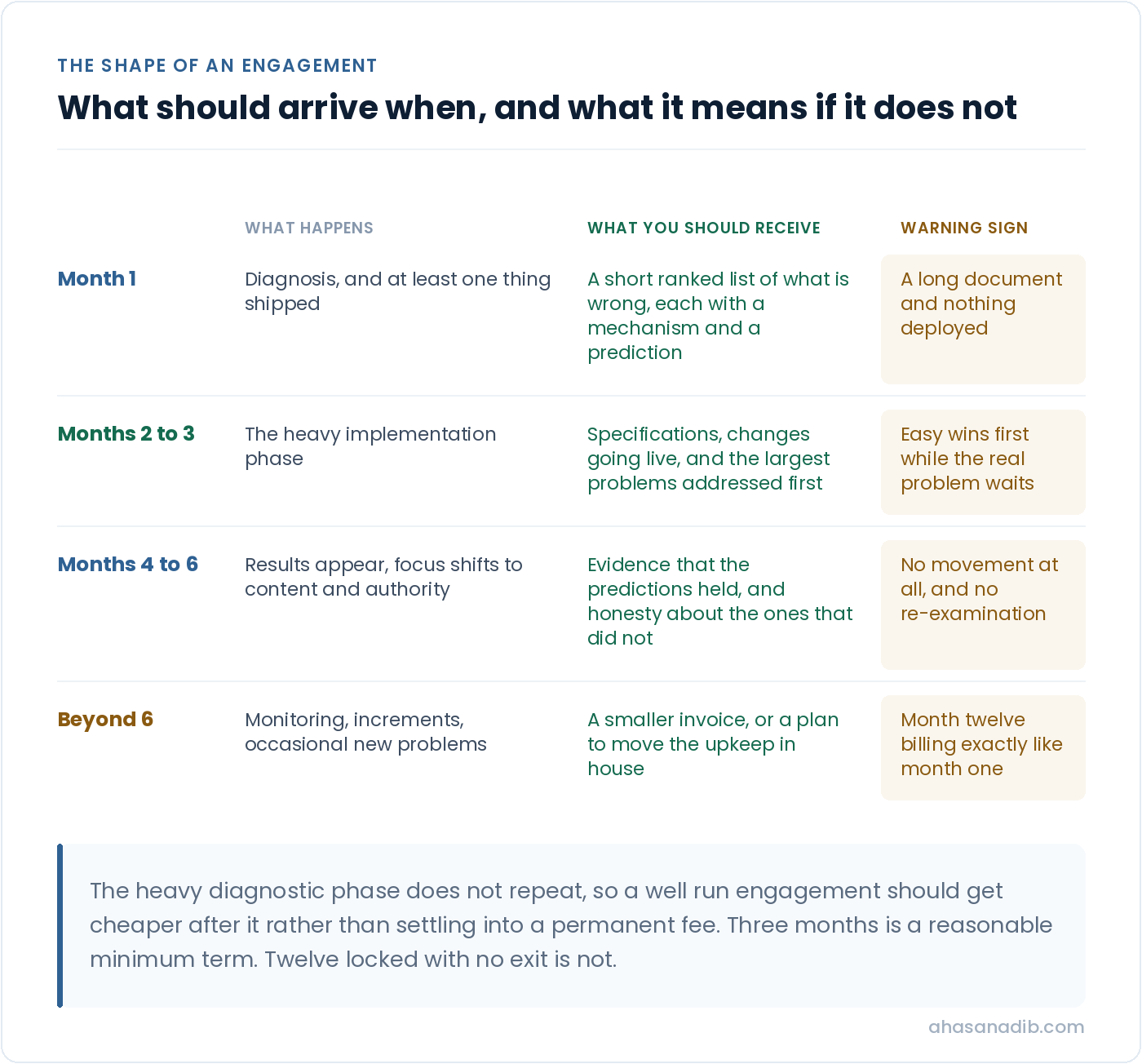
The first month is diagnosis and quick wins. I want two things out of it: a clear picture of what is wrong, and at least one thing shipped, because an engagement that produces nothing deployable in the first month tends to keep not producing.
Months two and three are the heavy implementation phase. This is when the largest problems get fixed, and it is the most expensive and most valuable part of the engagement. It is also when patience is hardest, because the work is happening and the graph has not moved yet.
Months four to six are where the results of that work start appearing and the focus shifts toward content and authority, which are slower and more compounding. If nothing has moved at all by the end of month six on a site that had a real technical problem, something is wrong with the diagnosis and I should be saying so rather than waiting for you to ask.
Beyond six months, the honest position is that the work should be getting cheaper, not settling into a permanent fee. The heavy diagnostic phase does not repeat. What remains is monitoring, incremental content and the occasional new problem, and a good deal of that can move in house. I say this to clients directly, and it costs me revenue, and it is still the right advice.
On contracts, be wary of long minimum terms. Three months is reasonable, because nothing meaningful can be demonstrated in less. Twelve months locked with no exit is somebody protecting their revenue rather than your outcome.
Consultants are not interchangeable
The title covers a wide range of quite different jobs, and hiring the wrong specialism is a common and expensive mistake.
A technical specialist works on whether search engines can crawl, render and index your site properly. You need one when pages are missing from the index, when a migration has gone wrong, or when a large catalogue is not being discovered. A content and strategy consultant works on what you publish and which questions you own. You need one when you are indexed and visible but not for anything commercially valuable. A local specialist works on map pack visibility and proximity, which is a genuinely separate discipline with its own rules. An ecommerce specialist works on the specific pathologies of product catalogues, faceted navigation and duplicate variants.
The mismatch to avoid is hiring for the specialism you find most interesting rather than the one your problem needs. If your pages are indexed and ranking on page two, a technical consultant will find things to fix and your traffic will not move. If half your product pages are missing from Google, a content strategist will write excellent pages nobody sees.
A generalist consultant is the right answer for most small and mid-sized businesses, because the constraint moves over time and you want somebody who can tell you when it has moved. That is broadly what I do, and I go deepest on the technical and strategy ends of it.
What an SEO consultant costs
Since almost nobody on page one gives a number, here are mine and the ranges around them.
My ongoing work runs between £1,500 and £5,000 a month depending on the size of the site, how much I am implementing rather than specifying, and how much of the wider programme is included. One-off audits are quoted after looking at the site rather than from a price list.
Across the market, independent consultants commonly sit between £60 and £150 an hour, with monthly retainers in the low thousands. Agencies typically start higher. There is a large tier below all of it on freelance marketplaces, and at that end you are usually buying tool output rather than judgement.
The thing worth understanding about the pricing is that it is front loaded in value even when it is flat in billing. The first three months carry most of the benefit. A retainer that never changes shape is worth questioning by month six. I have set out the reasoning behind my own pricing on the freelance SEO consultant page.
When you should not hire an SEO consultant
Turning down work I cannot make succeed is cheaper for me than taking it.
Your site is brand new with very little content. There is nothing to diagnose yet. Publish twenty genuinely useful pages first, and get the basics right yourself, which is a weekend of reading rather than a retainer.
Nobody can make changes to your site for the next three months. This is the most common reason an engagement fails and it has nothing to do with SEO. If your developer is booked solid and there is no budget for outside implementation, you will pay me to produce a document that sits in a queue. Wait.
You need revenue within eight weeks. Search is not the channel for that. Paid acquisition is, and telling you so is the correct answer even though it sends you elsewhere.
Your business does not have a search problem. If your customers find you by referral and your category has almost no search volume, a consultant will produce activity rather than growth. I would rather establish that on a free call than four months into a retainer.
You want somebody to execute a plan you have already decided on. That is a contractor rather than a consultant, and you will be paying consultant rates for typing. Hire accordingly and pay less.
How to tell a good one from a bad one
Briefly, because I have written this out properly elsewhere.
Ask them to explain something specific about your site in language you can follow. Ask what they would fix first and why that one. Ask how they will know whether it worked, and listen for a metric with a direction and a timeframe rather than an unfalsifiable phrase about SEO health. Ask what they would not bother fixing, which is hard to fake without real judgement. And ask who is actually doing the work, because at an agency the person selling to you is frequently not the person who opens your data.
The full version of that, with the shape of a strong answer against a weak one, is in my guide to hiring a technical SEO expert, and it applies to generalists just as well.
SEO consultant FAQs
What does an SEO consultant do day to day?
Most of the week goes on diagnosis and on getting fixes implemented, rather than on optimising pages. A typical week starts with reading what changed in the data, moves into investigating one problem properly, includes a conversation about a decision, and ends with writing specifications and following up on what did or did not ship. The visible output is deliberately small, because a consultant producing a large volume of documentation every week is usually producing documentation instead of results.
Are SEO consultants worth it?
They are worth it when you have a search problem you cannot diagnose yourself, and somebody available to implement the fixes. They are not worth it when your site is brand new with almost no content, when nobody can make changes for the next quarter, or when you need revenue inside two months. The value is concentrated in correct prioritisation, so if you already know exactly what is wrong and just need it done, you are better served by a contractor at a lower rate.
What is the difference between an SEO consultant and an SEO agency?
A consultant is the person you assessed, working on your account directly, with no account layer and usually a lower cost per hour of genuine expertise. An agency gives you coverage, capacity for large projects, and several specialisms under one roof, at the cost of distance between the person who sold to you and the person doing the work. Neither is better in the abstract. An agency suits a migration or a large multi-workstream programme; a consultant suits a business that wants one experienced person making the decisions.
How much does an SEO consultant cost?
Independent consultants commonly charge between £60 and £150 an hour, with monthly retainers usually in the low thousands. My own ongoing work runs from £1,500 to £5,000 a month depending on scope, and audits are quoted after looking at the site rather than from a price list. Be sceptical of any number given before somebody has seen your site, because it is a template price that will be applied regardless of what you needed.
How long before an SEO consultant produces results?
Indexation changes can appear in days to weeks because you are changing what search engines can access. Ranking and traffic changes usually take one to three months, and competitive terms take longer. A reasonable expectation is something deployed in month one, the heavy work in months two and three, and visible movement between months four and six. If nothing has moved by the end of month six on a site with a real diagnosed problem, the diagnosis deserves re-examination.
Do I need an SEO consultant or can I do it myself?
For a small site on a mainstream platform, a great deal of the basics are genuinely do it yourself, and a weekend of reading gets you most of the way. What you cannot easily do yourself is diagnose why something is not working when the obvious things are already right, because that depends on pattern recognition across many sites. Hire when you are stuck rather than when you are starting.
What skills does an SEO consultant need?
Technical literacy sufficient to read what a crawler and a browser are telling you, analytical judgement to separate the findings that matter from the hundreds that do not, and enough commercial sense to prioritise by revenue rather than by best practice. The underrated one is communication, because a correct diagnosis that nobody implements produces exactly nothing, and a large part of the job is making a technical argument to people whose priorities lie elsewhere.
Where I would start
Before you speak to anyone, do these three things.
Write down what you actually want, in numbers. More traffic is not a brief. Enquiries from people searching for what you sell is a brief, and it changes which specialism you need.
Find out whether you can implement. Ask your developer honestly how much capacity exists in the next quarter. If the answer is none, fix that before hiring anybody, because it is the constraint that quietly wastes the most money in this field.
Then talk to two or three people and compare how they answer rather than what they charge. The difference between somebody who reasons from your evidence and somebody who recites categories is obvious within ten minutes, and it matters far more than the difference in their quotes.
If you want to start with the diagnosis rather than a commitment, that is what a technical SEO audit is for, and you can see the kind of outcomes this work has produced on my results page. If you would rather just ask someone whether you have a problem worth paying to solve, that is what the call is for, and I will tell you if the answer is no.
Not sure whether you need one yet?
Bring your site to a free call. I will tell you whether you have a search problem worth paying to solve, and if the honest answer is that your money is better spent elsewhere, I will say that instead.
Book a free call →